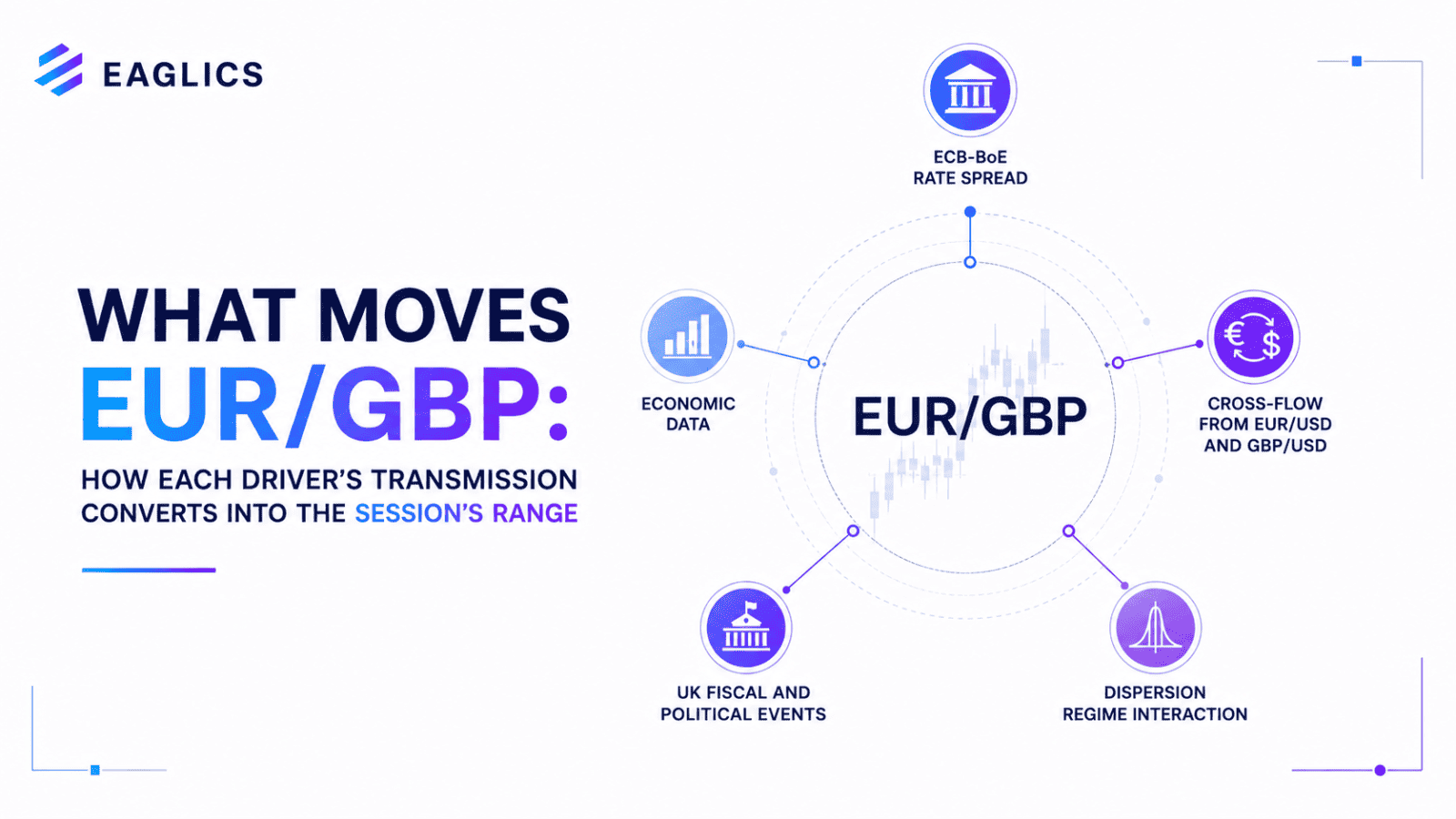
Five structural inputs drive EUR/GBP, but each one transmits differently. The ECB-BoE rate spread does not produce the same pip impact at the 2-year tenor as it does at the 10-year. A CPI miss of 0.1 percentage points transmits differently from a miss of 0.4. A broad dollar rally that moves EUR/USD and GBP/USD equally leaves EUR/GBP near unchanged. A UK budget announcement stays elevated for two to five sessions; a PMI miss resolves the same day.
Understanding the transmission profile of each driver, not just that it exists, is what converts a list of inputs into a pre-session planning framework.
1. ECB-BoE Rate Spread: Why Tenor Matters More Than the Rate Level
The ECB-BoE rate spread drives EUR/GBP's medium-term direction, but the spread level matters less than which tenor is moving.
- 2-Year Spread: The FX market prices this continuously into EUR/GBP. It is forward-looking, reflecting where each central bank's rate will be over the next two years, not where it is today. When the 2-year spread moves on a statement surprise, vote split, or guidance shift, EUR/GBP replicates in that session, before the next decision has occurred.
- 5-Year and 10-Year Spreads: These matter for structural long-term positioning but are too slow-moving to drive intraday EUR/GBP range formation.
Practical Transmission Difference:
A 10bp shift in 2-year spread expectations from an unexpected MPC dissenter → 15 to 25 pip EUR/GBP move within the session.
The same 10bp shift through a 5-year bond yield revision → fractional intraday impact, slow structural drift across subsequent sessions.
The Eaglics model's macro conditioning layer processes the front-end and back-end spread signals as separate factor inputs, because their transmission speed, magnitude, and session impact are not equivalent.
2026 Example: The Bank of England held at 3.75% in June 2026 on a 7-2 vote, with two members voting to raise it to 4%, according to the Bank of England's official June 2026 Monetary Policy Summary. That vote split shifted 2-year BoE rate expectations more than the headline hold did, signalling the next BoE move might be a hike. EUR/GBP fell on a hold decision because the 2-year tenor repricing moved in sterling's favour.
2. Economic Data: Why Consensus Deviation Drives Range, Not the Absolute Print
EUR/GBP does not respond to UK CPI at 3.0% in isolation. It responds to UK CPI at 3.0% when the consensus was 2.6%, a 0.4 percentage point surprise. The transmission mechanism is driven entirely by how far the print deviates from the market's prior expectation, not by the level of the statistic.
A print that confirms expectations, even at an elevated level, produces minimal range expansion. No rate repricing is required. A print that departs from consensus forces an immediate recalculation of the next central bank meeting's probability distribution.
A single CPI print that misses consensus by 0.3 percentage points can shift EUR/GBP by 60 to 80 pips in under an hour. That is an 85 to 115 percent expansion above the standard 40 to 70 pip daily profile, the session's entire typical range consumed in a single candle on a surprise of less than half a percentage point.
Transmission Magnitude by Data Type: Ordered Highest To Lowest:
Data Type | Transmission Magnitude | Why |
CPI (UK or Eurozone) | Highest | Directly conditions next meeting's decision probability |
PMI Composite | High | Most current forward growth indicator; monthly frequency |
GDP Quarterly | Moderate | Structurally significant but anticipated, revised, slower-moving |
Employment Data | Variable | Impact depends on whether it reshapes central bank's near-term view |
The Eaglics model's event calendar input identifies which data type is scheduled before each session. The macro conditioning domain weighting shifts upward accordingly, adjusting the forecasted zone's width before the session opens.
3. Cross-Flow from EUR/USD and GBP/USD: The Proportional Differential Problem
EUR/GBP equals EUR/USD divided by GBP/USD. The transmission from dollar pair movements is not linear, it is proportional. This is the most mechanically precise of the five drivers and the one most commonly misread.
When EUR/GBP Does Not Move on a Dollar Event
EUR/USD rises 60 pips. GBP/USD rises 60 pips. Same dollar event, same magnitude. EUR/GBP moves approximately zero, both legs shifted by the same proportion and the ratio is unchanged.
When EUR/GBP Does Move on a Dollar Event
EUR/USD rises 60 pips. GBP/USD rises 30 pips. EUR/GBP moves approximately the proportional differential, not from any Eurozone or UK fundamental, but from a USD event that affected the two legs differently.
EUR/GBP is calculated synthetically from EUR/USD and GBP/USD rates, unlike dollar-based majors, it reacts primarily to the policy divergence between the Bank of England and the ECB, as well as to UK-EU trade dynamics, with geographic proximity between the two economies compressing volatility relative to pairs like GBP/JPY.
The Eaglics cross-flow factor captures the proportional divergence between EUR/USD and GBP/USD as a separate orthogonalized input, not the raw pip movement in either pair. This is structurally different from adding both dollar pairs as separate inputs: uncollapsed, they share a common USD component that produces collinearity rather than independent information in the factor library.
The full methodology is documented in the Eaglics Research Framework.
4. UK Fiscal and Political Events: Event Type Determines Transmission Duration
UK fiscal and political events are not one driver, they are four structurally distinct event types, each with a different magnitude, duration, and residual regime impact.
Government Budget Announcement (Fiscal Credibility Surprise)
Highest single-session transmission magnitude of any EUR/GBP driver.
Session range can more than double the standard 40 to 70 pip profile.
Residual regime elevation persists for 2 to 5 subsequent sessions, gilt repricing, rating agency commentary, and institutional repositioning extend dispersion beyond the announcement date.
Volatility regime tag remains elevated across multiple sessions, not just the announcement day.
Bank of England Vote Split Surprise
Sharp intraday transmission concentrated in the two hours following the announcement.
Partial reversion follows as the market recalibrates forward expectations.
Residual regime impact resolves within one session, information is fully digested faster than a budget.
June 2026 example: the 7-2 split transmitted into 2-year BoE rate spread pricing immediately; EUR/GBP fell on what was technically a hold decision.
Political Transition or Leadership change
Two-phase transmission: initial sterling risk premium as uncertainty prices in, followed by partial reversion as continuity becomes clearer.
Duration of elevated regime depends on pace of political clarity.
Smooth succession compresses the risk premium quickly; contested transition extends it across multiple sessions.
PMI or CPI Miss (UK-Specific Data)
Shortest transmission duration of the four event types.
Intraday range expands on release; BoE rate expectations reprice within minutes.
Session extreme forms in the release window; pair returns to standard dispersion regime the following session.
Exception: a severe miss that shifts the structural MPC narrative extends the elevated regime further.
The Eaglics model classifies each event type separately before generating the forecasted zone. A volatility regime tag around a budget uses different weighting than the same tag around a PMI release. because their transmission duration and residual dispersion impact differ materially.
The EUR/GBP Forecast 2026 article maps the macro scenario implications of the H2 2026 event calendar.
5. Dispersion Regime Interaction: Why the Same Driver Produces Different Range Outcomes
The fifth input is not a driver in the same sense as the other four, it is the conditioning layer that determines how much of any driver's theoretical transmission magnitude actually appears in the daily range.
EUR/GBP's long memory regime has been quantitatively classified as mean-reverting using Hurst exponent analysis. A Hurst exponent below 0.5 indicates anti-persistence, above-average moves followed by below-average moves. EUR/GBP's Hurst exponent has consistently measured below 0.5 across multiple rolling windows in its 2003-to-present price history. This is not a market observation, it is a measurable statistical property of the pair's price process, confirmed across multiple rate cycles and political regimes.
How The Dispersion Regime Amplifies or Compresses Each Driver
Driver | Quiet Regime | Expansion / Extreme Regime |
ECB-BoE rate spread | Standard structural drift contribution | Wider structural repricing per basis point |
Economic data surprise | Range expands within compressed baseline | 0.3pp CPI miss → 90 to 110 pips instead of 60 to 80 |
Cross-flow differential | Proportional impact at reduced baseline magnitude | Same differential produces larger absolute pip move |
Fiscal event | Range doubles from a lower starting point | Range can breach historical standard deviation by 2+ standard deviations |
This is why the Eaglics volatility regime tag, low, normal, or elevated, is the first output in every pre-session forecast, before the forecasted high and before the forecasted low. The regime classification tells participants whether the day's drivers will transmit at standard magnitude or amplified magnitude before a single London tick occurs.
If you need in-depth knowledge, read our EUR/GBP Technical Analysis article that covers how the dispersion percentile changes the function of structural price levels within the session.
How the Eaglics Model Processes All Five Profiles Simultaneously
The five transmission profiles are not processed independently. Inside the Eaglics model they enter a 108-factor orthogonalized library that removes collinearity before any factor reaches the ensemble:
Front-end and back-end rate spreads → separate factors.
Proportional cross-flow differential → orthogonalized against the rate spread domain.
Four UK fiscal event types → classified and weighted separately in the macro conditioning layer.
Dispersion percentile → conditions the ensemble weighting, not a standalone input.
After orthogonalization, the 108 factors pass through a multi-model ensemble of five architecturally distinct model families. The regime-aware meta-learner determines how much weight each family contributes, based on which has historically produced the lowest volatility-normalized forecast error in the current dispersion regime. In an expansion regime adjacent to a central bank decision, weighting shifts toward the families that have best captured event-day transmission. In a quiet consolidation regime, weighting shifts toward families that have best captured structural level boundaries.
The output is the pre-session EUR/GBP Daily Range Forecast: a specific high, a specific low, a confidence score, and a volatility regime tag, derived before London opens.
Frequently Asked Questions
How Does the ECB-BoE Rate Spread Tenor Affect EUR/GBP Differently?
The 2-year spread drives intraday EUR/GBP range formation because it prices forward policy expectations immediately. A 10bp shift in 2-year expectations from a vote split surprise moves EUR/GBP 15 to 25 pips within the session. The same shift through 5-year or 10-year yields produces a slower structural drift across subsequent sessions, not an intraday range move.
Why Does a Broad Dollar Rally Sometimes Leave EUR/GBP Unchanged?
EUR/GBP equals EUR/USD divided by GBP/USD. When EUR/USD and GBP/USD fall by the same proportion, EUR/GBP barely moves, the ratio is unchanged. EUR/GBP moves on the proportional difference between the two dollar pairs. A dollar event that moves both legs equally produces a near-zero EUR/GBP response regardless of how large the dollar move is.
How Much Does a UK CPI Surprise Move EUR/GBP?
A CPI print missing consensus by 0.3 percentage points can shift EUR/GBP by 60 to 80 pips in under an hour, an 85 to 115 percent expansion above the standard 40 to 70 pip daily average. The transmission is driven by surprise magnitude relative to consensus, not by the absolute level. A print confirming expectations produces minimal expansion regardless of the level.
Why Does EUR/GBP Stay Elevated Longer After a Budget Than After a PMI Miss?
A UK budget surprise carries residual regime elevation for 2 to 5 sessions, gilt repricing, rating agency commentary, and institutional repositioning extend dispersion beyond the announcement. A PMI miss transmits intraday and resolves within the same session. Each event type has a structurally different transmission duration, which the Eaglics model classifies separately before generating the forecasted zone.
How Does Eaglics Process EUR/GBP Drivers Without Double-Counting related inputs?
The Eaglics 108-factor library applies systematic collinearity removal before any factor enters the ensemble. Front-end and back-end rate spreads are separate. The proportional cross-flow differential is orthogonalized against the rate spread domain. Related inputs are separated so each carries independent, non-redundant information into the forecasted zone calculation.

Comments 0
Leave a comment anonymously, or add your email. Your email is never displayed.