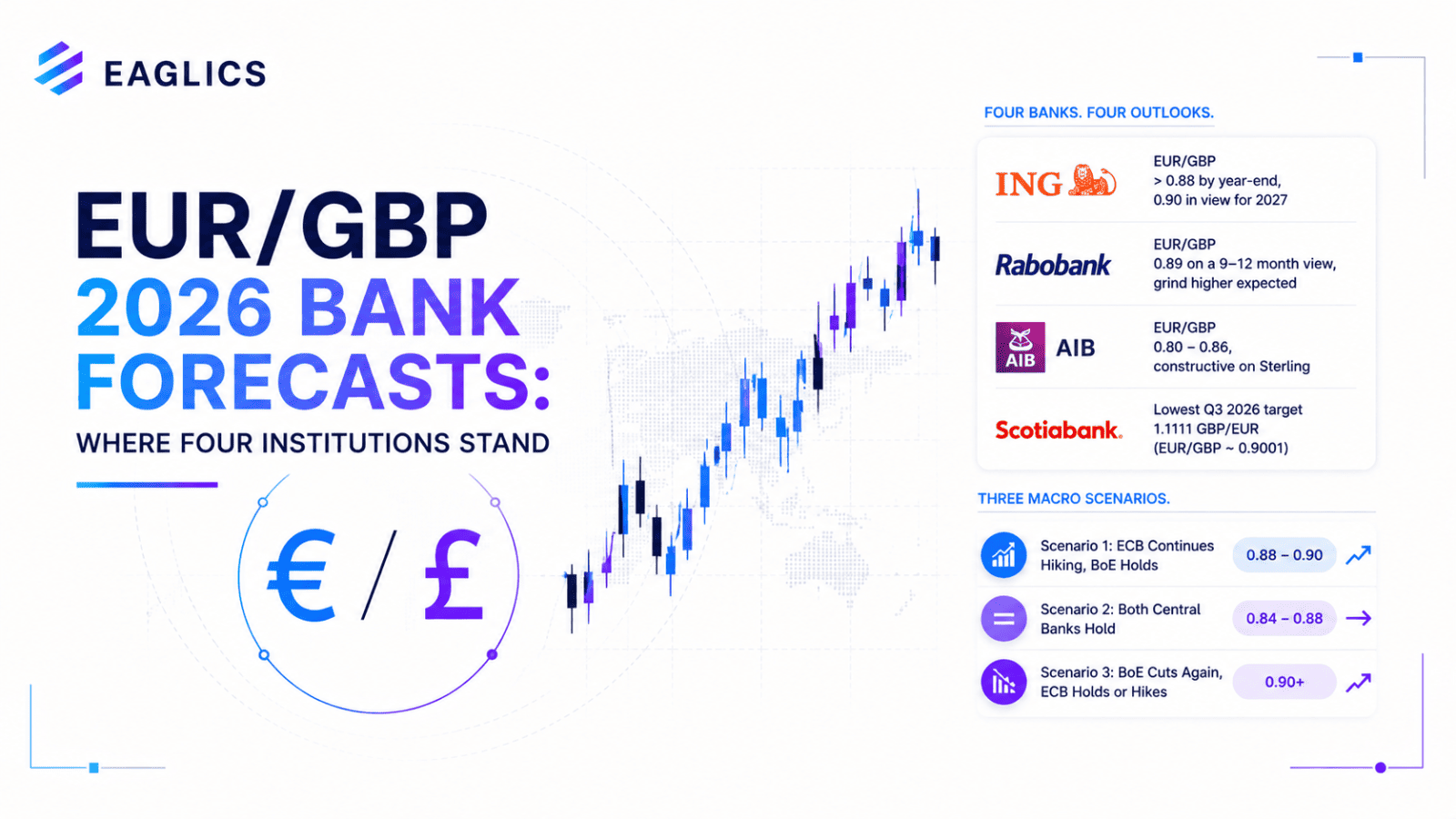
EUR/GBP entered 2026 with a clear structural thesis: the ECB had finished tightening before the Bank of England, the BoE was cutting while the ECB held, and that policy differential was compressing the rate spread in sterling's favour. The pair reflected that dynamic, EUR/GBP fell from a March 2026 high near 0.877 to a July low near 0.847 as the BoE's relative hawkishness held. Then June 2026 changed the equation. The ECB raised its deposit rate to 2.25%, the first ECB increase since September 2023, while the Bank of England held at 3.75% on a 7-2 vote. The rate spread inverted from the BoE's side. EUR/GBP recovered.
The 2026 annual outlook is no longer a consensus story. The bank forecasts diverge sharply across institutions, each reflecting different assumptions about the ECB-BoE rate path, UK fiscal credibility, and the pace at which the euro's macro tailwind from German fiscal stimulus sustains. That divergence makes the current EUR/GBP environment a regime-sensitive one, the pair's daily range, structural direction, and probable session boundaries all change depending on which policy scenario resolves.
The EUR/GBP complete Structural Guide covers the pair's foundational mechanics. This article covers the four bank forecasts, three macro scenarios, and what each means for the daily range that the Eaglics pre-session model produces for every London session.
EUR/GBP in 2026: The Macro Context That Defines Every Session's Forecasted Zone
EUR/GBP's 2026 trajectory has been shaped by a single structural force: the ECB-BoE 2-year rate spread. The Bank of England cut to 3.75% through December 2025 as UK inflation eased from its 2023-2024 peak. The ECB, having completed its tightening cycle later than the BoE, remained on hold through Q1 2026 before resuming hikes in June. That sequence created the inversion: as of late July 2026, the BoE rate stands 150 basis points above the ECB deposit rate, but the direction of travel has reversed, with the ECB now the tightening institution and the BoE the one on hold.
This is the macro context that feeds directly into the Eaglics model's macro conditioning layer every session. The ECB-BoE 2-year rate spread is a live input in every EUR/GBP daily forecast, not as a directional call but as one of 108 orthogonalized factors that determine the session's probable range width and regime classification. In an environment where the rate spread is actively compressing, as it was through Q2 2026, the model's directional persistence factors reflect a drift regime rather than a consolidation regime. When the spread stabilises, the pair's long memory regime reverts toward its mean-reverting character and the forecasted zone narrows accordingly.
The current environment as of early August 2026 is one of regime transitions: the ECB's June hike has been priced but its next move remains uncertain. The BoE's August meeting, on 7 August 2026, is the first policy event that will either confirm or challenge the rate spread trajectory that has defined 2026. That event proximity directly elevates the Eaglics volatility regime tag for surrounding sessions, the expansion regime classification reflects the elevated probability that the session's realized volatility exceeds EUR/GBP's standard 40 to 70 pip dispersion profile.
EUR/GBP 2026 Bank Forecasts: Where Four Institutions Stand
ING: EUR/GBP Above 0.88 by Year-End, 0.90 in View for 2027
ING's G10 FX Outlook 2026 argues that EUR/GBP trading above 0.88 represents a return to levels last seen in early 2023, driven by the macro adjustment where fiscal policy is being loosened in the Eurozone and tightened in the UK. ING forecasts EUR/GBP to rise above 0.88 by year-end, with further gains projected into 2027 and EUR/GBP potentially reaching 0.90. ING's case rests on three structural pillars: German fiscal stimulus sustaining Eurozone growth momentum through H2 2026 and into 2027; UK fiscal tightening continuing to weigh on sterling; and the BoE delivering another 75 basis points of cuts before the ECB tightening cycle peaks.
The 0.90 target is ING's conservative upside scenario, not their base case; they flag European political risk as the primary downside to the EUR/GBP bullish thesis. The daily range implication of the ING scenario is a sustained drift regime through H2 2026, with the pair's directional persistence factors in the Eaglics model reflecting upward bias during sessions where the macro conditioning input is aligned with the rate spread compression thesis.
Rabobank: 0.89 on a 9-to-12-Month View, Grind Higher Expected
Rabobank's central view is that EUR/GBP is likely to creep higher to 0.89 on a 9-to-12-month view, driven by UK political risks, fiscal concerns, and a likely re-pricing of Bank of England rate expectations. Rabobank projects EUR/GBP at 0.85 in one month, 0.87 in three months, 0.88 in six months and 0.89 at both the nine- and twelve-month horizons, with domestic politics forming a key part of the case.
Rabobank's framework is explicitly fiscal-political rather than purely monetary. The bank's analytical case rests on sterling's vulnerability to UK gilt market volatility, specifically the risk that ongoing fiscal uncertainty under the new Burnham administration generates intermittent gilt selling that pressures sterling on a recurring basis. The daily range implication of the Rabobank scenario is a series of elevated-regime sessions around UK fiscal events rather than a smooth directional drift, consistent with the Eaglics volatility regime expansion classification that accompanies budget announcements and fiscal credibility events.
AIB: 0.80-0.86, Constructive on Sterling
Allied Irish Bank occupies the opposing position among the major institutional forecasters. AIB's framework targets EUR/GBP trending lower into the 0.80 to 0.86 range, citing stronger UK economic fundamentals relative to the Eurozone and recently secured UK trade agreements as sterling tailwinds. AIB's base case requires the Bank of England to hold rates higher for longer while Eurozone growth disappoints below the German fiscal stimulus thesis that ING and Rabobank are pricing.
The AIB scenario is the lowest EUR/GBP target among the banks in coverage, and the one that requires the most significant departure from the 2026 macro trajectory established so far. If AIB's scenario resolves, the daily range implications are a compression regime: EUR/GBP returning to its standard 40 to 70 pip dispersion profile in a narrower structural band, with the Eaglics volatility regime tag spending more sessions in the quiet classification.
Scotiabank: Lowest Q3 2026 Target in the Survey at 1.1111 GBP/EUR (EUR/GBP ~0.9001)
Scotiabank holds the lowest forecast among the 21-bank survey for Q3 2026 at a GBP/EUR rate of 1.1111, implying EUR/GBP near 0.9001, the most bearish sterling view in the current consensus. Scotiabank's view represents the tail of the distribution rather than the consensus, it requires both ECB tightening continuation and a significant UK political or fiscal shock to materialise. The significance of the Scotiabank position is what it implies about the distribution of outcomes: the range between AIB's floor (EUR/GBP ~0.80-0.86) and Scotiabank's ceiling (~0.90) is 400-plus pips, a distribution too wide to plan around without a regime-conditional framework.
3 Macro Scenarios and Their Daily Range Implications
Scenario 1: ECB Continues Hiking, BoE Holds: EUR/GBP Drift Toward 0.88-0.90
This is the scenario that ING and Rabobank are pricing as their base case. If the ECB delivers a further rate increase at its September 11 or October 30 2026 meeting while the Bank of England holds at its August 7 and September 18 meetings, the ECB-BoE 2-year rate spread compresses further. EUR/GBP drifts higher on institutional positioning that reflects the widening ECB-BoE carry differential.
Daily Range Implications: The pair's directional persistence factors in the Eaglics model shift toward the drift classification. The forecasted zone expands slightly, drift regimes carry wider probable boundaries than consolidation regimes. Session-to-session continuity increases: the forecasted high of one session tends to sit above the prior session's realized high as the structural level migrates upward. Volatility regime tags trend toward normal-to-expansion around the ECB meeting dates in September and October.
Scenario 2: Both Central Banks Hold: Consolidation Regime, 0.84-0.88 Range
If both the ECB and the Bank of England hold through the remainder of 2026, no further ECB hikes, no BoE cuts, EUR/GBP enters a consolidation regime defined by the existing 150 basis point rate spread. The pair oscillates inside the established structural range: 0.847 at the 2026 floor, 0.877 at the March 2026 high, with no new directional catalyst to break either boundary.
Daily Range Implications: This is the environment where EUR/GBP's mean-reverting long memory regime is most fully expressed. The fractal memory regime reverts to its dominant historical classification. The Eaglics volatility regime tag spends more sessions in the quiet-to-normal classification. The forecasted zone narrows toward the lower end of EUR/GBP's standard 40 to 70 pip dispersion profile. Structural price levels at 0.847, 0.854, 0.860 and 0.877 become the reliable range boundaries that the EUR/GBP Technical Analysis framework treats as the primary pre-session reference points.
Scenario 3: BoE Cuts Again, ECB Holds or Hikes: EUR/GBP Accelerates Toward 0.90+
The most EUR/GBP-bullish scenario requires the Bank of England to resume cutting, either from a deterioration in UK growth data, a UK fiscal credibility event that forces a dovish response, or a political transition that shifts the BoE's reaction function. In this scenario, the ECB-BoE spread compresses from both sides simultaneously. EUR/GBP breaks above the March 2026 high of 0.877 and establishes a new structural range.
Daily Range Implications: This is the scenario where the Eaglics volatility regime tag most frequently classifies sessions as expansion or extreme. The dispersion percentile for EUR/GBP rises above its trailing median, reflecting a pair that is repricing structurally rather than oscillating inside a consolidation band. The forecasted zone widens in the expansion regime classification, the model's regime-aware meta-learner increases the weight of the dispersion expansion component when the macro conditioning input signals an active repricing environment. The logged forecast history table on the EUR/GBP Forecast that documents exactly how each regime classification has translated into forecasted zone width across prior sessions.
The H2 2026 Event Calendar: Sessions That Carry Elevated Range Expansion Risk
The following events carry direct EUR/GBP range expansion risk for H2 2026. Each one shifts the Eaglics volatility regime tag for surrounding sessions toward the expansion classification, meaning the pre-session forecasted zone widens before the event and the confidence score reflects the elevated uncertainty about the session's realized range.
Event | Date | EUR/GBP Range Expansion Risk |
Bank of England MPC decision | 7 August 2026 | HIGH: 7-2 vote split at June meeting; first decision under elevated ECB-BoE spread |
ECB Governing Council decision | 11 September 2026 | HIGH: First post-June decision; potential second consecutive hike |
Bank of England MPC decision | 18 September 2026 | HIGH: Adjacent to ECB decision; policy response under scrutiny |
ECB Governing Council decision | 30 October 2026 | MEDIUM-HIGH: Post-Q3 growth data; ECB rate path confirmation |
UK Autumn Budget | October 2026 | HIGH: Fiscal credibility event; sterling-specific range expansion risk |
Bank of England MPC decision | 5 November 2026 | MEDIUM: Post-budget assessment |
On each of these dates, the Eaglics model's event calendar input shifts the regime classification for the session and the sessions immediately surrounding it. Participants planning around the EUR/GBP daily range on these dates should expect the volatility regime tag in the pre-session forecast to reflect elevated conditions.
What the 2026 Forecast Divergence Means for the Eaglics Model's Daily Output
The 400-pip spread between the lowest (AIB, ~0.80-0.86) and highest (Scotiabank, ~0.90) institutional EUR/GBP forecasts for 2026 is not a planning framework, it is a measure of macro uncertainty. What it means for the Eaglics model is this: the annual directional scenario is not the input. The session's current factor environment is the input.
Every day before the London open, the Eaglics model processes the ECB-BoE rate differential as it stands that morning, the overnight cross-flow factor from EUR/USD and GBP/USD, the current dispersion percentile, and the event calendar proximity. Those inputs determine the pre-session forecasted zone for that specific session, not for the year. The annual forecast divergence between ING and AIB is captured inside the model's macro conditioning layer: the rate spread, the fiscal event calendar, and the cross-flow factor all reflect whichever of the three macro scenarios is currently in resolution.
This is the operational distinction between an annual directional forecast and a daily pre-session range forecast. The annual forecast answers the question of where EUR/GBP might be at year-end. The Eaglics model answers the question of where today's London session is most likely to establish its high and low, given everything that is observable before the open. Both are useful. They answer different questions.
Frequently Asked Questions
What Is the Consensus EUR/GBP Forecast For Year-end 2026?
Bank forecasts diverge significantly for EUR/GBP in 2026. ING targets above 0.88, Rabobank projects 0.89 on a 9-to-12-month view, while AIB holds a more constructive sterling view targeting 0.80 to 0.86. The divergence reflects different assumptions about the ECB-BoE rate path and UK fiscal credibility.
Will EUR/GBP Go Up or Down in 2026?
The structural bias for H2 2026 is upward for EUR/GBP if the ECB continues hiking while the Bank of England holds at 3.75%. The ECB raised it to 2.25% in June 2026. If both central banks hold, EUR/GBP consolidates inside the 0.847 to 0.877 range established in H1 2026.
What Is the Highest EUR/GBP Bank Forecast for 2026?
Rabobank targets EUR/GBP at 0.89 on a 9-to-12-month view. ING forecasts above 0.88 by year-end with 0.90 cited as a conservative upside target for 2027. Scotiabank holds the most bearish sterling view among the surveyed institutions at EUR/GBP near 0.9001 for Q3 2026.
How Do Annual EUR/GBP Forecasts Affect the Eaglics Daily Range Output?
Annual bank forecasts do not directly set the Eaglics forecasted zone. The model processes the current session's factor environment, ECB-BoE rate spread, cross-flow factor, dispersion percentile, event calendar, to produce a daily pre-session high and low. The macro scenario in resolution is captured through live factor inputs, not through applying an annual target to the session's range.
Does Eaglics Adjust its EUR/GBP Forecast Around Major Policy Events?
Yes. The Eaglics model's event calendar input adjusts the volatility regime classification for sessions surrounding ECB and Bank of England decisions, UK budget announcements, and major data releases. The volatility regime tag, low, normal, or elevated, in the pre-session output reflects this adjustment directly before each event session.

Comments 0
Leave a comment anonymously, or add your email. Your email is never displayed.