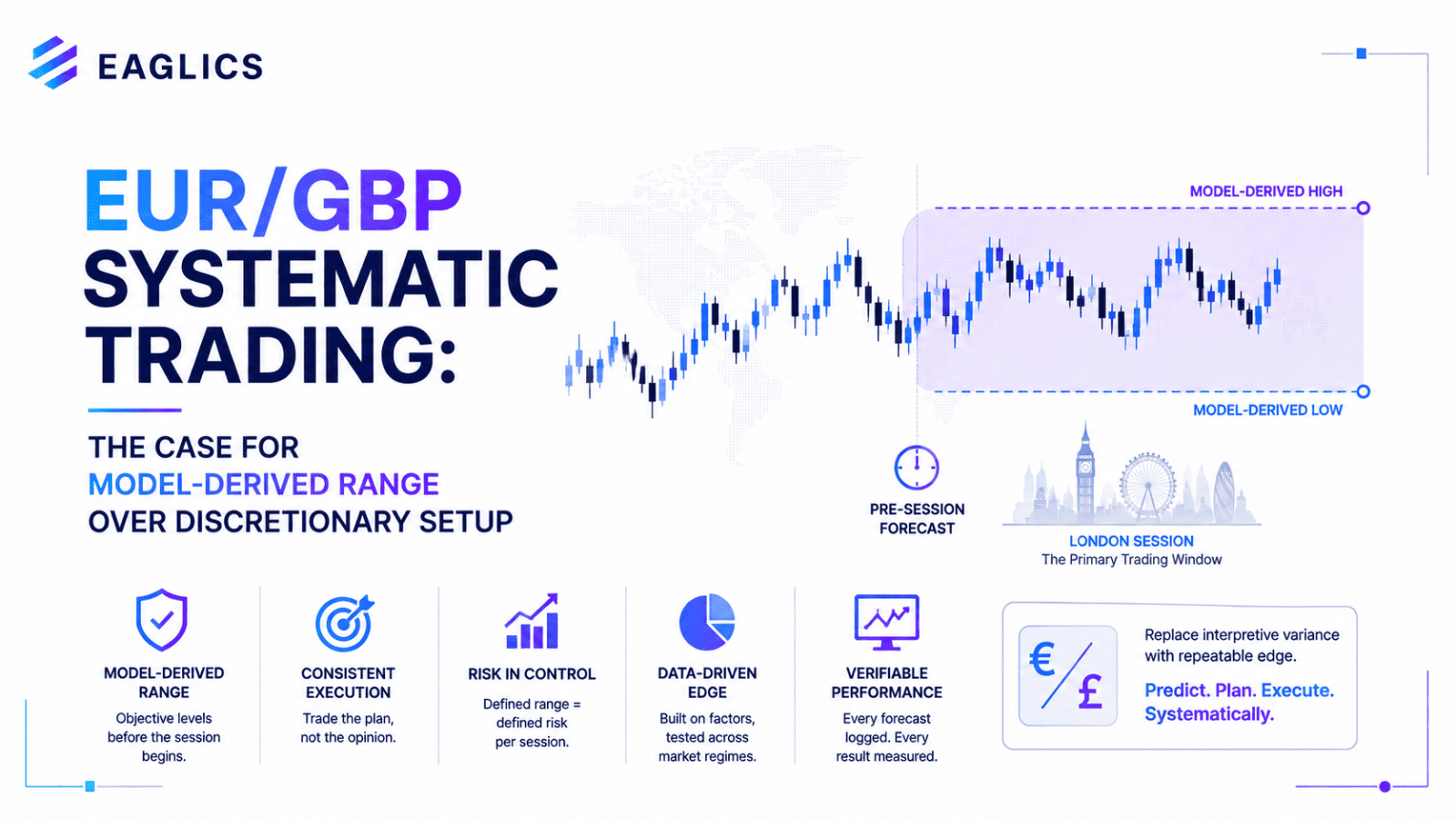
Systematic EUR/GBP trading is not about automation. It is about reproducibility. A systematic approach produces the same analytical output from the same inputs every session before price has moved, before the chart has formed a pattern, before any interpretation has occurred. The output does not depend on how the session feels, what yesterday's candle looked like, or whether the analyst carries a bias from a prior position. The process runs. The output is the same.
Discretionary EUR/GBP analysis cannot make this claim. The same price structure interpreted by the same analyst on two different mornings produces different outputs depending on recent results, emotional state, and prior positioning. Confirmation bias, recency bias, and anchoring to recent price action introduce variance that accumulates across sessions into an inconsistent planning framework.
EUR/GBP amplifies this problem. On a pair that averages 40 to 70 pips daily and concentrates its range in a single London session window, a 10-pip misreading of where the probable high sits is not a rounding error. It is 14 to 25 percent of the day's total range.
What Makes EUR/GBP Suitable for Systematic Approaches?
EUR/GBP is one of the most systematically tractable instruments in the major FX universe for three structural reasons.
Factor Stability
The ECB-BoE rate differential has been the dominant medium-term directional input on EUR/GBP across multiple rate cycles dating back to the pair's creation in 1999. The cross-flow relationship with EUR/USD and GBP/USD is enforced by a mathematical identity that arbitrage prevents from breaking. These are structural features of the pair's construction that persist across regime changes, not temporary statistical relationships.
Range Forecastability
EUR/GBP's mean-reverting long memory regime, confirmed by a Hurst exponent consistently below 0.5 across its 2003-to-present price history, means the pair's daily range has historical bounds that are forecastable with higher accuracy than a trend-persistent instrument. The bounds compress in quiet dispersion regimes and expand in event-driven expansion regimes, but they are not random. A systematic model calibrated to EUR/GBP's specific dispersion distribution extracts information from those bounds that a discretionary framework cannot consistently replicate.
London Session Concentration
The 70 to 80 percent of EUR/GBP's daily range forms inside the London session. According to the BIS 2025 Triennial Central Bank Survey, global OTC FX turnover reached $9 trillion per day in April 2025, up 28 percent from $7 trillion in 2022, with the UK retaining the largest single-country share of that turnover. A pre-session forecast delivered before 07:00 GMT covers the window where the pair's range almost entirely forms.
The Problem with Discretionary EUR/GBP Analysis
Interpreting the Same Structure Differently Session to Session
EUR/GBP presents a particular challenge for discretionary analysis: its price structure looks similar across most sessions. The pair oscillates inside 100 to 200 pip bands for extended periods. There are no persistent trends to anchor a directional bias. Each session's chart, viewed in isolation, looks like the previous one.
This similarity creates a confirmation bias trap. An analyst who believes EUR/GBP is forming a base at 0.8500 will find evidence for that thesis in most sessions during a consolidation phase. An analyst who believes the pair is breaking higher will find supporting structure in the same chart. Neither interpretation is generated from the session's actual factor environment. Both are generated from the analyst's prior belief filtered through the current chart.
The systematic alternative eliminates this entirely. The Eaglics model's 108-factor orthogonalized library does not have a prior belief about EUR/GBP's direction. It processes the session's factor environment and outputs the forecasted zone. The output is the same regardless of what the analyst thought yesterday.
Confirmation Bias Before the Session Opens
Discretionary analysis typically begins with the chart. The price is already visible. The analyst sees where EUR/GBP closed yesterday, where it gapped overnight, what the Asian session range looks like. All of that visual information anchors interpretation before any factor-based analysis occurs.
The Eaglics model's structural ex-ante lag enforcement prevents this. The model is structurally prevented from touching any observation that is still forming at forecast generation time. All factor inputs are historical: closed sessions, settled rates, finalised release data. The output is derived without seeing the current day's price action. It is genuinely pre-session in a way that discretionary analysis cannot be.
For participants who want the structural confluence framework within which the pre-session output operates, the EUR/GBP Technical Analysis article covers the H4 and daily chart structure in full.
How a Quantitative Range Model Removes Interpretive Variance?
1. The Same Inputs Produce the Same Output Every Session
The Eaglics model runs from a fixed pipeline. Before every London open:
The 108-factor orthogonalized library is populated with the current session's inputs, all historical, all point-in-time compliant.
Systematic collinearity removal ensures no two factors carry redundant information
The regime-aware meta-learner determines ensemble weighting based on the current dispersion percentile.
The five-model ensemble produces the forecasted high and low.
The confidence score and volatility regime tag are generated from the same pipeline.
Reproducibility is structural. It is enforced by the pipeline, not by discipline. The output is the same for the same inputs regardless of who runs it, what the previous session did, or what the prior bias was.
2. Regime Classification Adjusts Thresholds Without Manual Recalibration
One of the most common failure modes in discretionary EUR/GBP analysis is carrying a framework calibrated for a quiet regime into an expansion regime and expecting the session's range to stay within the standard 40 to 70 pip bounds when a central bank decision or fiscal event has shifted the pair into a materially different dispersion environment.
The Eaglics regime-aware meta-learner addresses this automatically. The dispersion classification, MEAN REVERT, NORMAL, EXPANSION, EXTREME, adjusts the ensemble's weighting and the forecasted zone's width without manual intervention. A session preceding the BoE meeting receives an expansion regime tag not because someone decided to apply it, but because the model's dispersion percentile reading, event calendar proximity factor, and macro conditioning layer together produce that classification from the current factor environment.
No manual recalibration. No session-to-session judgment about whether today is a volatile day. The regime classification is the output of the same systematic pipeline that produces the forecasted zone.
3. The Pre-Session Output Is Available Before Price Has Moved
The EUR/GBP forecasted high and low are published before the London open, before the session's first institutional order flow has established any intraday structure. This timing is the operational requirement of a pre-session systematic framework, not incidental.
Discretionary analysis that begins after the London open is reactive by definition. The price has already moved. The first 30 minutes of the session, the heaviest institutional order flow window, have already produced structure that anchors all subsequent interpretations. A pre-session output derived before any of that structure exists is a genuinely independent input, not a post-hoc rationalisation of what price has already done.
4. Accuracy Is Logged Against Every Session: Verifiable, Not Self-Reported
Every Eaglics EUR/GBP forecast is recorded against the realised session result in the full history table. No sessions are excluded. The accuracy record is not self-reported. It is the unedited log of every forecast versus every outcome, available to any participant evaluating the model before any commercial decision.
This is the operational meaning of purged walk-forward validation in a live forecasting context. In model development, purged walk-forward validation means every evaluation split uses a purge window around the boundary to prevent data leakage. In live deployment, the equivalent discipline is the unedited logged history: every prior forecast alongside every realised result, with no sessions removed because the model underperformed.
A Rigorous Walk-Forward Validation Framework prevents lookahead bias, maintains full interpretability, and extends naturally to any hypothesis generation approach. This is the standard that separates auditable systematic research from self-reported backtests.
5. Orthogonalized Factors Prevent Multicollinearity From Distorting the Output
Multicollinearity, when two or more factors share a common information component, is one of the most common ways a systematic framework produces confident but wrong outputs. When two correlated factors both enter the ensemble, their shared information is double-counted, inflating the apparent weight of that information source and distorting the forecasted zone.
The Eaglics factor library applies systematic collinearity removal before any factor enters the ensemble. The ECB-BoE 2-year rate spread and the ECB-BoE 5-year rate spread are both informative but share a common policy trajectory component. After orthogonalization, only the independent component of each survives in the library. The cross-flow factor from EUR/USD and GBP/USD is orthogonalized against the rate differential domain, removing the component already captured by the spread factors before the cross-flow factor enters the ensemble.
The result: 108 factors that each carry distinct, non-redundant information. The forecasted zone reflects the full breadth of the session's factor environment without any single information source being inadvertently amplified by correlated duplicates.
How Recursive Calibration Keeps the Model Current
A systematic model built on historical data decays as market structure evolves. The ECB-BoE rate spread that drove EUR/GBP in 2018 had different transmission dynamics from the 2026 spread because the absolute level of rates, the composition of central bank communication, and the UK's post-Brexit trade structure have all changed. A model that fixes its parameters at a historical training point and runs them forward without updating will gradually diverge from the pair's actual behaviour.
The Eaglics model addresses this through recursive calibration. After every session closes, the realised outcome is compared against the forecast. The weights inside the ensemble are updated to minimise the error between the forecast and the realised range. No session is discarded. No manual adjustment is required. The update runs on the closed session's data before the next session's forecast is generated.
Three mechanisms maintain accuracy across changing regimes:
Recursive Calibration: Weights update after every closed session, not on a quarterly or annual retrain cycle.
Rolling Bias Correction: A rolling window checks for systematic directional offset; if the model is consistently forecasting the high too far above the realised high across recent sessions, the correction engages automatically.
Directional Drift Guard: If directional accuracy degrades below a threshold across a rolling window, the guard engages and flags the degradation before it compounds.
Together these three mechanisms mean the model does not require a participant to manually assess whether it is still working. The recursive architecture either maintains accuracy or flags when it does not, in both cases transparently.
Volatility-Normalised Accuracy: What the Logged Record Actually Measures
Raw pip accuracy is not a meaningful metric across different dispersion regimes. An 8-pip error in a quiet regime session with a 45-pip range is a very different result from an 8-pip error in an expansion regime session with a 110-pip range. The first error represents 17.8 percent of the session's range. The second represents 7.3 percent.
Volatility-normalised accuracy expresses the forecast error as a proportion of the session's realised volatility, making the metric comparable across quiet and expansion regime sessions.
What This Means in Practice
Session Type | Range | Forecast Error | Volatility-Normalised Error |
Quiet regime | 45 pips | 5 pips | 11.1% |
Expansion regime | 95 pips | 9 pips | 9.5% more accurate despite larger raw error |
The EUR/GBP Forecast Today at Eaglics logs every session's forecast against the realised result. Any participant can verify these calculations directly through the unedited session-by-session log, not through a summary statistic presented by the model's developer.
EUR/GBP Systematic vs Algorithmic: Two Different Uses of the Same Forecast
Systematic and algorithmic trading are frequently conflated but describe different relationships to the pre-session forecast output.
Systematic | Algorithmic | |
Definition | Uses model output as the pre-session planning input; execution is rule-based but human-placed | Uses model output as an automated execution signal; no human in the execution loop |
How forecast is used | Forecasted high and low define entry zones; participant places orders manually when price reaches the zone | Forecasted high and low are parsed by execution software; orders placed automatically when thresholds are met |
Confidence score role | Determines position sizing before the session; lower confidence means smaller position | Determines order size programmatically |
Regime tag role | Informs stop placement and target width before execution | Adjusts automated stop and target parameters |
Applicable to | All participant types: systematic desk, prop firm, advanced discretionary, side-income | Algorithmic desks, systematic hedge funds, automated execution environments |
The Eaglics pre-session forecast serves both use cases from the same output: forecasted high, forecasted low, confidence score, and volatility regime tag. The full methodology behind the model's construction is documented in the Eaglics Research Framework.
How to Integrate the Pre-Session Output Into a Daily Systematic Workflow
A systematic EUR/GBP workflow built around the Eaglics pre-session output has a defined sequence.
Before the London Open
Check the volatility regime tag, determining whether structural price levels function as boundaries (Mean Reverting) or reference points (expansion/extreme).
Note the confidence score, determines position sizing relative to the session's allowable risk budget.
Map the forecasted high and low against the prior session's value area boundaries and weekly composite value area, any alignment elevates confidence in the forecasted boundary.
Set entry orders at the forecasted high and low with stops beyond the forecasted level.
Set target at the opposite forecasted boundary.
During the London Session
No new entries outside the forecasted zone, the framework defines where positions are taken.
If the forecasted boundary is not reached, no position is taken, protecting the day's allowable loss budget entirely.
If an expansion regime event occurs mid-session, manage the existing position against the regime tag's implications, not against an in-session reinterpretation.
After the Session Closes
Log the realised high and low against the forecast, the same discipline the Eaglics model applies to its own logged history.
Note whether the session's realised dispersion aligned with the regime tag.
No adjustment to the framework based on a single session's outcome, systematic discipline means the framework is evaluated across a rolling window, not modified session-to-session.
For participants applying this workflow within a prop firm evaluation context, the EUR/GBP Prop Firm Trading article covers how the pre-session framework converts reactive evaluation decisions into rule-based execution.
Frequently Asked Questions
What is EUR/GBP Systematic Trading?
EUR/GBP systematic trading produces the same analytical output from the same inputs every session before the price has moved. A systematic framework eliminates interpretive variance: the session's factor environment determines the forecasted zone, not the analyst's prior belief or how the chart looks that morning.
Why Does EUR/GBP Suit a Systematic Approach More than a Discrecy?
EUR/GBP's mean-reverting long memory regime, factor stability, and London session concentration make its daily range forecastable from a fixed set of structural inputs. Discretionary analysis introduces session-to-session variance that is costly on a pair where a 10-pip interpretive error represents up to 25 percent of the day's total range.
What is Purged Walk-Forward Validation and Why Does it Matter?
Purged walk-forward validation evaluates a model on data it has never seen, with a purge window around each evaluation split to prevent any test period information contaminating the training period. It separates an auditable systematic accuracy claim from a self-reported backtest. The Eaglics logged history applies the equivalent discipline in live deployment: every session's forecast is recorded against every realised result with no sessions removed.
How Does the Confidence Score Affect Position Sizing?
The confidence score quantifies the model's certainty about a session's factor environment. A high confidence score supports standard position sizing relative to the session's allowable risk budget. A lower score, produced when the factor environment contains unusual combinations or when the dispersion percentile is transitioning between regimes, signals reduced position sizing independently of the forecasted zone's width.
What is the Difference Between EUR/GBP Systematic and Algorithmic Trading?
Systematic trading uses the pre-session model output as a planning input with human-placed execution. Algorithmic trading uses the same output as an automated execution signal with no humans in the execution loop. The Eaglics pre-session forecast, forecasted high, low, confidence score, and regime tag, is structured to serve both use cases from the same output.

Comments 0
Leave a comment anonymously, or add your email. Your email is never displayed.