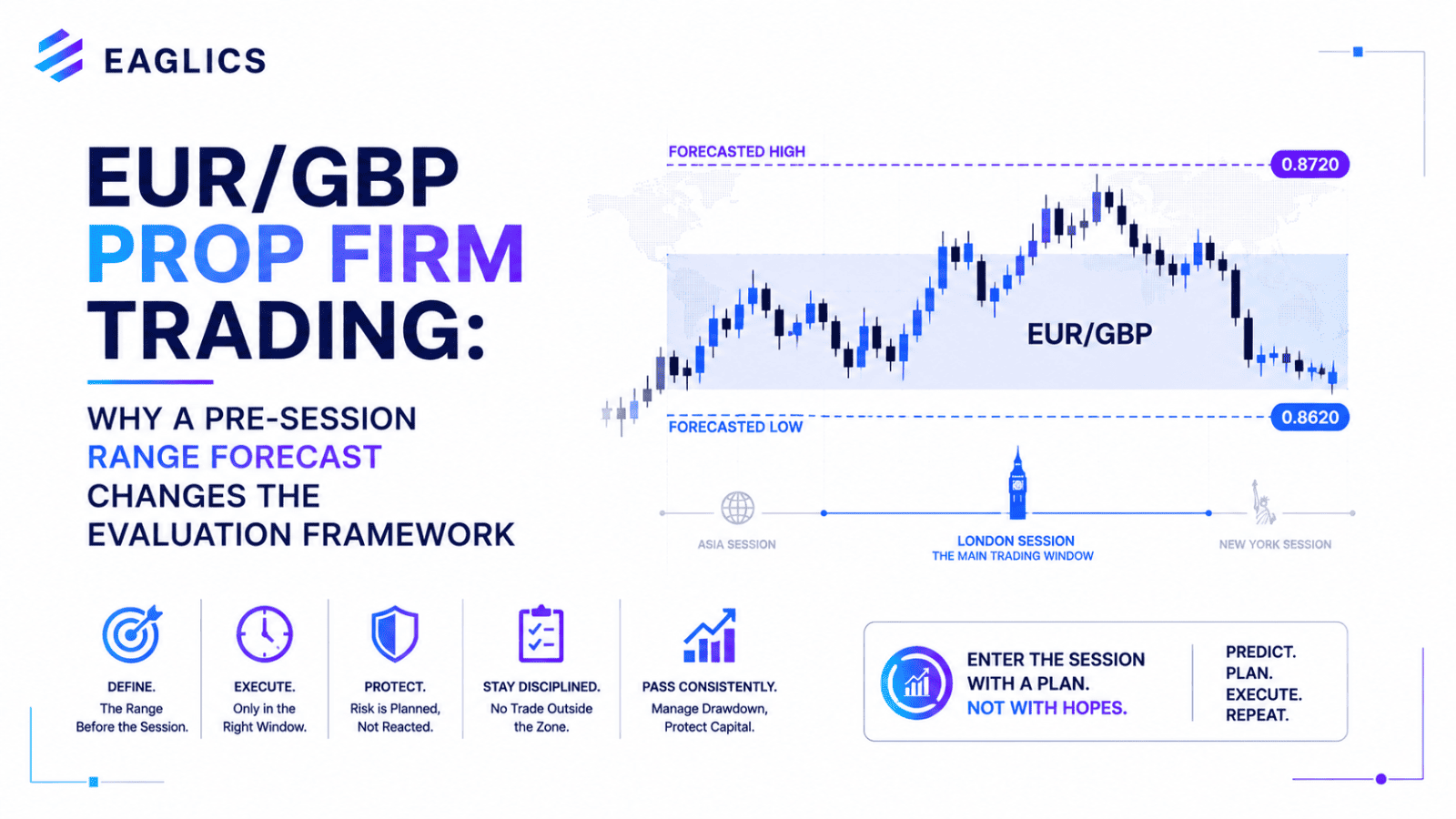
Prop firm evaluations are not won by finding the right trade. They are won by not committing the violations that fail most participants, breaching the daily loss limit, widening stops reactively when a position moves against the plan, taking a second position after the first has already consumed a significant share of the day's allowable loss. The evaluation framework rewards one behaviour above all others: rule-based execution inside defined risk parameters, repeated consistently across every session of the evaluation period.
EUR/GBP is structurally suited to that constraint. The pair averages 40 to 70 pips of daily range, the tightest major cross in forex. It concentrates 70 to 80 percent of that range inside the London session from 07:00 to 16:00 GMT. It mean-reverts more than it trends. Its structural levels hold across weeks and months. These are not general virtues of the pair, they are the specific characteristics that make EUR/GBP forecastable at the session level, and that forecastability is what the Eaglics pre-session model delivers every trading day before the London open.
This article covers what the evaluation framework actually demands, and precisely how a pre-session EUR/GBP Forecasted High and Low satisfies those demands before the session begins.
Why EUR/GBP Is Structurally Suited to Prop Firm Evaluations
Tight Daily Range: Predictable Risk Per Session
EUR/GBP's 40 to 70 pip average daily range produces a structurally predictable risk environment for evaluation participants. A 40-pip session means that a position entered with a 15-pip stop, targeting a 30-pip move, risks approximately 37 percent of the day's total range to gain approximately 75 percent, a ratio that is manageable within a 3 to 5 percent daily loss limit without requiring outsized position sizing.
On wider-ranging instruments, GBP/USD at 80 to 130 pips, GBP/JPY often above 100 pips, the same stop-to-target structure consumes a larger proportion of the day's range, and an adverse move from a single position can consume the daily loss limit in a fraction of a session. EUR/GBP's compressed range profile creates a natural alignment between position risk and the evaluation's daily drawdown architecture.
Prop firm evaluations are governed by five core rules that determine almost every failure: profit target (typically 5 to 10 percent), maximum drawdown (5 to 10 percent), daily loss limit (3 to 5 percent), minimum trading days, and banned strategy clauses. EUR/GBP's range profile fits inside that architecture more precisely than any wider pair because the daily range itself is narrow enough that a pre-session forecasted boundary defines the session's probable extremes with meaningful accuracy.
London Session Concentration: One Defined Active Window
EUR/GBP's London session concentration from 07:00 to 16:00 GMT solves one of the evaluation's structural problems: position monitoring across multiple session windows. On pairs with significant Asian and New York session activity, an evaluation participant managing positions across three session windows carries exposure to overnight gaps, weekend risk, and session-transition volatility that all consume daily drawdown room without the participant being actively at their desk.
Additional Notes: Read EUR/GBP Technical Analysis: 5 technical confluences every participant should know.
EUR/GBP concentrates its range formation in a single nine-hour window. The Asian session contributes 5 to 10 percent of daily range at most. The New York overlap extends what London has established rather than creating new session extremes. The practical consequence is that an evaluation participant trading EUR/GBP plans once, before the London open, and executes within that single active window. The session's probable high and low are established within the London window. The daily drawdown risk is concentrated within defined hours, not distributed across 24 hours of global FX activity.
Mean-Reverting Long Memory Regime: Range-Based Execution Logic
EUR/GBP's fractal memory regime classifies the pair as mean-reverting through the majority of its trading history. Its directional phases require a sustained and widening ECB-BoE 2-year rate spread, a condition present in specific policy cycle windows and then resolved. Between those phases, the pair oscillates inside established structural levels, repeatedly testing and rejecting the same zones across weeks and months.
This mean-reverting long memory regime is the structural basis for range-based execution logic on EUR/GBP. A position entered at the lower boundary of the session's expected range, the pre-session forecasted low, targets the upper boundary of that range as its objective. On a mean-reverting pair, that target has structural support from the pair's own historical tendency to oscillate within a predictable band. The directional persistence factors in the Eaglics model quantify this tendency as a live input in each session's forecasted zone.
If you want to know about how EUR/GBP's daily high and low are actually formed, you can read our Structural Guide of EUR/GBP.
The Evaluation Problem: What Gets Participants Eliminated
Discretionary Overtrading Outside a Defined Setup
The most common cause of evaluation failure is not a single catastrophic loss, it is a pattern of small discretionary trades taken outside a defined setup, each consuming a fraction of the daily loss limit until the cumulative effect breaches it. A participant who enters a third position because the first two did not reach target, or who takes an unplanned trade because price moved sharply and created the appearance of an opportunity, is operating reactively rather than within a pre-defined execution framework.
Most failed evaluations come from breaching a measurement mechanic, equity versus balance, trailing versus static drawdown, server-time resets, rather than from a genuinely bad trade. The implication is direct: evaluation failure is predominantly a rule and mechanics violation, not a strategy failure. A pre-session forecasted zone that defines where positions are placed and where they are not,before the session opens, eliminates the condition that produces most of those violations.
Chasing Extension Moves Beyond the Session's Typical Range
EUR/GBP's 40 to 70 pip average range means that a session which has already moved 50 pips from its open carries a structurally low probability of extending a further 30 pips in the same direction inside normal dispersion conditions. A participant who enters a directional position after the session has already established a 50-pip move is positioning for a range extension event, an elevated dispersion regime, inside what may be a quiet or normal regime session.
Without a pre-session framework that defines the session's probable range before price has moved, this error is nearly invisible. The move looks like momentum. The chart shows a breakout. The entry feels justified by what price is doing rather than by where it sits inside the session's probable range. The Eaglics volatility regime tag, low, normal, or elevated, addresses this directly: it tells the participant before the session opens whether the current dispersion conditions support a range extension or a standard mean-reversion session.
The full pipeline behind that output is documented in the Eaglics Research Framework. For participants using the EUR/GBP systematic trading framework alongside the prop firm evaluation structure, the pre-session output serves both purposes simultaneously, a model-derived range that eliminates discretion from the evaluation and from systematic execution.
Widening Stops Reactively Rather Than Pre-Session
Stop placement defined reactively, adjusted after a position moves against the plan, is the most direct route to a drawdown breach in an evaluation. A position entered with a 15-pip stop that is widened to 25 pips because the participant believes the trade is still valid has consumed 67 percent more daily loss budget than the original plan specified. On a 3 to 5 percent daily loss limit, that adjustment often makes the difference between a manageable losing day and a breach.
A pre-session forecasted zone eliminates the condition that produces reactive stop widening: the participant does not need to decide where the stop goes once the position is open because the stop was placed relative to the forecasted level before the position was entered. The forecasted low defines the level. The stop is placed beyond it. If the forecasted level does not hold, the stop is hit. The process is closed before the session opens.
You can also go through EUR/GBP Forecast 2026, so that you can have macro context about this pair.
How a Pre-Session Range Forecast Changes the Evaluation Framework
1. The Forecasted High and Low Become the Day's Planning Boundary
The Eaglics pre-session EUR/GBP forecast publishes a specific high and a specific low before the London open, alongside a confidence score reflecting the model's certainty for that session's factor environment and a volatility regime tag classifying the session as low, normal, or elevated. These three outputs, forecasted high, forecasted low, confidence score, regime tag, define the session's planning boundary before a single tick of London order flow has occurred.
For an evaluation participant, this means the day's execution framework is fully defined at the desk before the session opens. The positions are placed at the forecasted zone. The stops are defined relative to the forecasted level. The targets are set relative to the opposite boundary. Nothing in the session requires a real-time decision about where the range might extend, because the model has already specified the session's probable boundaries from its 108-factor orthogonalized library, conditioned on the current dispersion percentile and calibrated specifically for EUR/GBP's 40 to 70 pip average range profile.
2. Execution Happens When Price Reaches the Zone: Not Before
The operational discipline that a pre-session forecasted zone imposes is waiting. Price reaches the forecasted high or low, the position is placed. Price does not reach the forecasted boundary, no position is placed. The execution framework is binary. There is no discretionary decision about whether a move that fell short of the forecasted level by three pips was close enough to justify an entry. The forecasted level is the trigger, and the adaptive threshold in the Eaglics microstructure timing layer provides the implementation confirmation once price reaches the zone.
This waiting discipline is precisely what evaluation frameworks reward. A participant who takes no trades on a day where price does not reach the forecasted zone has protected their daily loss limit entirely. A participant who enters only at the forecasted boundary has defined their maximum risk for the session before the session opened. Both outcomes are evaluation-compliant. Neither requires a reactive decision inside the session.
3. Stops Are Defined Relative to the Forecasted Level Before the Session Opens
Stop placement on EUR/GBP within a pre-session forecasted framework follows a single rule: the stop is placed beyond the forecasted level, not inside it. If the position is a long entry at the forecasted low, the stop sits below the forecasted low, outside the boundary that the model has identified as the session's structural floor. If the forecasted low holds, the stop is not reached. If the forecasted low breaks, signalling that the session is resolving outside the model's standard accuracy band, the stop is hit and the loss is the pre-defined, pre-session-calculated amount.
This stop placement logic eliminates the reactive stop-widening pattern described in the evaluation problems section. The stop is not placed after the session opens. It is not adjusted because the position temporarily moved against plan. It is defined before the London open alongside the entry level, as part of the pre-session planning output.
4. No Trade Outside the Forecasted Zone Removes Reactive Entries
The pre-session forecasted zone defines not only where positions are placed but where they are not. A EUR/GBP move that occurs mid-session, away from the forecasted boundary, does not generate a position. A sharp move in either direction that appears to create momentum is not acted on unless price reaches the forecasted level. The forecasted zone is the filter that eliminates the discretionary reactive entries that consume the daily loss limit in patterns that are invisible until the cumulative breach.
For evaluation participants specifically, this filter has a second function: it eliminates the confirmation-bias-driven trade. A participant who has already watched EUR/GBP move 30 pips in one direction may interpret any continued momentum as confirmation of a trend. The pre-session forecasted zone prevents that interpretation from generating a position, because the position was either defined at the forecasted boundary before the session or it was not defined at all.
5. Daily Drawdown Limits Become Manageable When Range Is Pre-Defined
When the session's probable high and low are defined before the London open, the maximum loss exposure for the session is calculable before any position is entered. Position size is determined by the distance from the entry (the forecasted boundary) to the stop (beyond the forecasted level), expressed as a fraction of the account's daily loss limit. That calculation is made at the desk, before the session, from the pre-session output.
The lowest profit targets in prop firm evaluations in 2026 sit around 5 to 8 percent, paired with 4 to 5 percent daily loss limits and 8 to 10 percent maximum drawdown. Within those parameters, a EUR/GBP position sized to risk 1 percent of the account on a stop placed 12 pips beyond the forecasted boundary consumes 20 to 25 percent of the daily loss limit on a 4 to 5 percent daily loss architecture. That leaves 75 to 80 percent of the daily loss budget for the session's second setup, or available as protection if the first position's stop is reached. The pre-session calculation makes this arithmetic available before any risk is taken.
What the Eaglics EUR/GBP Forecast Gives Evaluation Participants That Real-Time Analysis Cannot
Real-time analysis of EUR/GBP during the London session produces a different type of input than a pre-session quantitative forecast. Real-time analysis responds to what price is doing, it is inherently reactive. The forecasted zone responds to what the session's structural factor environment implies before price has moved, it is inherently pre-session.
The operational distinction for evaluation participants is this: real-time analysis generates discretionary decisions inside the session. A pre-session forecasted zone generates a pre-defined execution framework that the session either validates or invalidates. For an evaluation where the primary failure mode is discretionary overtrading inside the session, the pre-session framework removes the condition that produces the failure.
The EUR/GBP daily range forecast is published before every London open. Every prior forecast is logged against the realized session result in the full history table, no sessions excluded, no accuracy claims without the record to support them.
Frequently Asked Questions
Why Is EUR/GBP a Good Pair for Prop Firm Evaluations?
EUR/GBP averages 40 to 70 pips of daily range, the tightest major cross in forex, and concentrates 70 to 80 percent of that range in the London session from 07:00 to 16:00 GMT. Its compressed range and single active window align precisely with the daily loss limit and defined-hours execution that prop firm evaluations reward.
What Causes Most Prop Firm Evaluation Failures?
Most evaluation failures come from breaching the daily loss limit through discretionary overtrading, reactive entries taken outside a defined setup, stops widened after a position moves against plan, or additional positions taken after the first has already consumed a significant share of the day's allowable loss. Rule-based execution within a pre-defined framework is the primary success factor.
How Does a Pre-session EUR/GBP Forecast Help with Prop Firm Evaluations?
A pre-session forecasted high and low defines the session's planning boundary before the London open. Entries are placed when price reaches the forecasted zone. Stops are set beyond the forecasted level before the session begins. No positions are taken away from the forecasted boundary. The daily maximum loss is calculable before any risk is taken.
What Does The Eaglics Volatility Regime Tag Mean for Prop Firm Participants?
The volatility regime tag, low, normal, or elevated, classifies the session's expected dispersion before the London open. In a low regime, the forecasted boundaries are reliable range limits and standard position sizing applies. In an elevated regime, position size should be reduced and the stop placed wider relative to the forecasted level to reflect the higher probability of range expansion beyond the standard profile.
Can I Use The Eaglics EUR/GBP Forecast During a Prop Firm Evaluation?
Yes. The Eaglics EUR/GBP pre-session forecast is a quantitative research output, a forecasted high, low, confidence score, and regime tag published before the London open. It is not a signal service and does not issue trade instructions. It defines the session's probable range boundaries, which the evaluation participant converts into a pre-session execution plan.

Comments 0
Leave a comment anonymously, or add your email. Your email is never displayed.